



Quick answer: Onion services include legitimate publishing and communities as well as illicit sites. This historical walkthrough illustrates that range; its screenshots are examples, not a current directory or an endorsement.
Welcome Back
In the previous installment, we started our unfiltered dive into the dark web by explaining the basics. Read Part 1 for the terminology.
Before we start, we want to reiterate that playing around on the dark web can have serious repercussions. Given its daunting and enigmatic reputation, most people have never ventured out to see what really exists on the dark web. We'll give you a peek behind the curtain so that you don't have to put yourself at risk!
SEVN-X does not endorse or condone any material or activities mentioned in this article, nor does it seek to provide commentary or regard with bias any of the sites, users, or material depicted. Screenshots are included for educational purposes only.
Are You Afraid of the Dark?
First things first, we must download and install the Tor browser. Because we can never be certain about what lurks out there, we set up throwaway Windows VMs in Amazon when doing research, investigations, and for this exploration. We highly discourage accessing the dark web on a device that contains any sensitive information.
Current Tor Browser guidance differs from the earlier version of this article: do not install extra extensions in an attempt to increase anonymity. Use the built-in security levels and consult the Tor Project’s current documentation. A research virtual machine is not a guarantee of anonymity or safety.
It is now time to start looking for web sites. But how do we find them? ...
Tor onion services use .onion addresses. Version 3 addresses contain 56 letters and numbers before that suffix. They do not inherently change frequently; an address can remain stable while the service keeps its keys. Old 16-character version 2 addresses no longer work on today’s Tor network.
We will try to locate a web resource known as a hidden wiki. Hidden wikis are sites that provide a directory listing to all kinds of websites, conveniently organized by category. Once we find a hidden wiki, we have quick and easy access to links for all kinds of web sites. The .onion address for a hidden wiki can actually be found on the surface web; after a quick search, we found a valid URL for a hidden wiki.
From here, we can also find specialized dark web search engines. Although not as robust, these search engines can still be quite helpful for finding sites not listed on hidden wikis.
With a plethora of URLs at our disposal, we can begin exploring...
What is Out There?
The dark web supports both legitimate activity and criminal misuse. Privacy, publishing, and censorship resistance are among the legitimate uses. Take freedom of speech, for example. It's not an inalienable right in every country.
Journalism
So for our first stop, we'll visit a journalism site. Here can be found an Afghan documentary detailing the experiences of exiles and their adverse journeys in a time of upheaval. The screenshot alone does not establish why the publisher chose an onion service.
 Controversial Investigative Journalism
Virus Maker?
Next on a general IT/security interest site, we found a program that generates customized computer virus executables. Based on the nature of the site and a related disclaimer, it seems like this is disseminated for educational and research purposes. However, one can imagine how this might be used in the wrong hands.
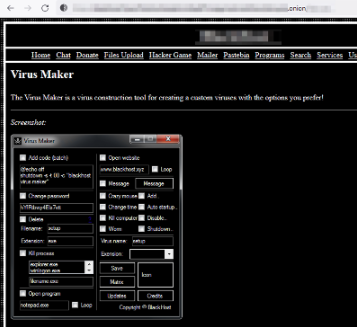 Virus Executable
Totally Tame
Some parts of the dark web attract users for perfectly innocuous activity. Below is a forum populated with threads discussing various art subjects.
 Art Forum on the Dark Web
Continue to Part 3 for a discussion of stolen-data listings and exposure response.
Frequently asked questions
Do onion addresses have to change frequently?
No. A version 3 onion address has 56 characters followed by .onion and can remain stable while the service retains its keys. Individual services may disappear or change addresses.
Should you add security extensions to Tor Browser?
The Tor Project discourages extra add-ons. Use Tor Browser’s built-in security levels and follow current Tor Project guidance rather than assuming an added extension makes browsing safer.